

At the end of 2025, Elephants Don’t Forget were joined by Jonathan Pearson, Head of Department for Consumer Policy and Outcomes at the FCA, for our end-of-year stakeholder event to discuss what the next chapter of Consumer Duty would mean in practice for firms in 2026.
In his opening statement, he made things clear regarding what the FCA expects in relation to competence and culture:
“If there’s one thing I want to emphasise today, it’s that Consumer Duty is not a checklist to be completed, but a mindset to be lived every day. Our goal is to move beyond compliance for its own sake and make fair treatment of customers the instinctive response at every level of your organisation.
This means that every interaction – whether it’s designing a product, supporting a customer, or making a strategic decision – should reflect a genuine commitment to delivering good outcomes. It’s about ensuring that fairness, transparency, and customer focus are woven into the fabric of your culture.
Competence under the Duty is not a one-off achievement. It requires ongoing learning, regular reflection, and a willingness to adapt as customer needs and expectations evolve. We must ask ourselves: are we listening to feedback, monitoring outcomes, and using what we learn to drive improvement?”
It struck me that – not since Nisha Arora declared that “Consumer Duty isn’t a once and done event” in 2023 – has the industry had a clearer clarification statement about the importance of employee competence, organisational culture, and the expectations the FCA has of firms under Consumer Duty.
Is competence decay fuelling poor customer outcomes? The evidence suggests it is highly probable.
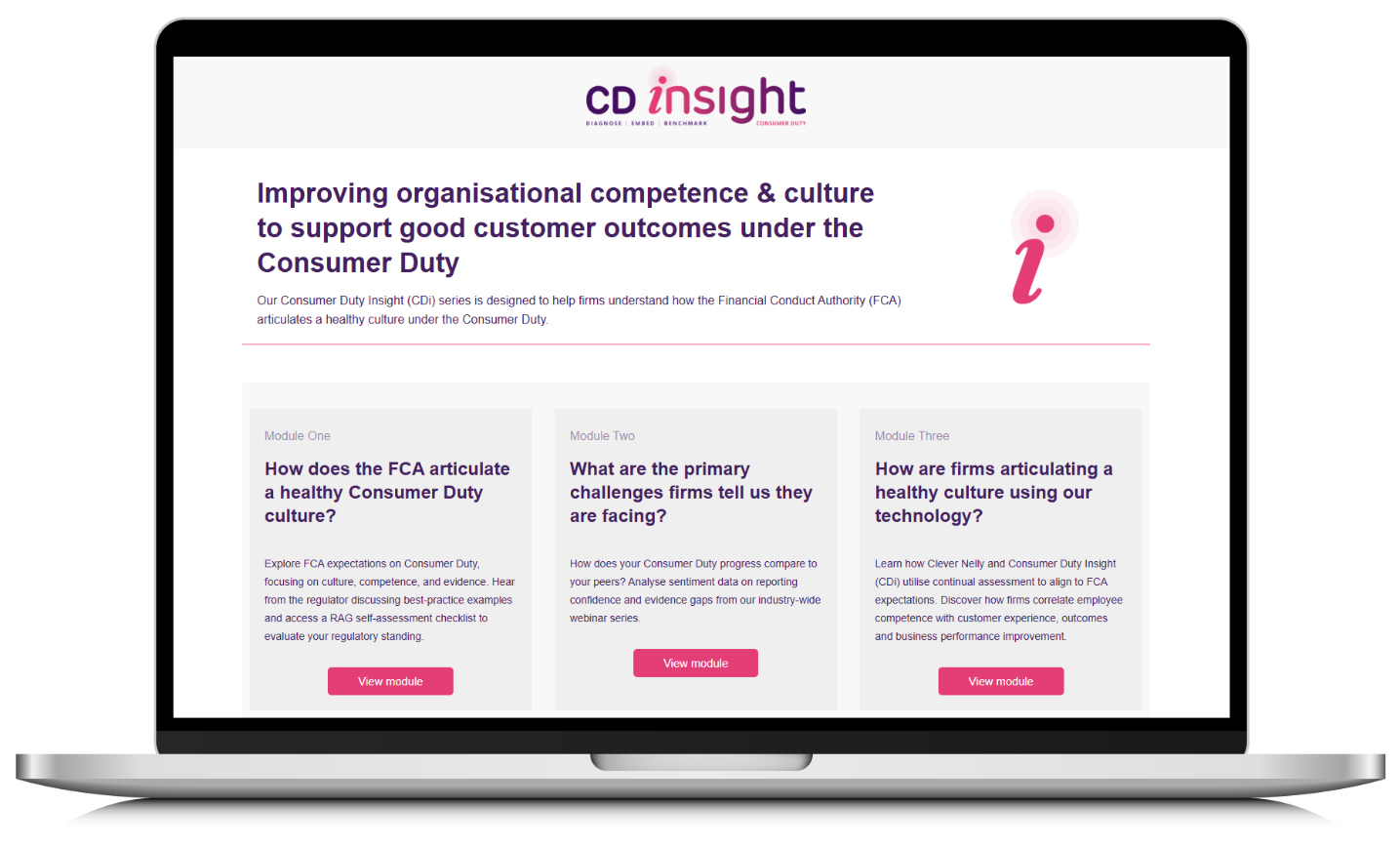
We’re pleased to share our findings from our engagement with the regulator with readers of T-CNews in the form of our new Consumer Duty Insight (CDi) series.
It’s a three-part modular series looking at how the FCA articulates a healthy culture under the Duty, the key challenges firms tell us they face, and how firms are using our technology to improve their learning culture, performance, and outcomes for their customers.
The catalyst for compiling the research and narrative for this resource came off the back of looking into the FCA’s approach to understanding culture in financial services.
Some readers may be familiar with a past FCA webinar – “Using assessment as a tool to understand culture” – which sought to explore different approaches to measuring it.
Of course, panellists offered differing perspectives on how they felt culture could and should be assessed – but the interesting outcome of the webinar was what they all agreed on.
Prominent themes such as moving away from “sea of green” dashboards, management being open to embracing where issues exist, and refusing to view culture and competence as a “tick-box” exercise.
Most importantly – certainly in relation to Consumer Duty – was an agreed sense that culture is driven by reality, not policy. It is dictated by the practical everyday actions of staff and that cultures operate best when leadership focuses on listening, actively seeks feedback, and views mistakes as learning opportunities.
We’ve asked firms about their feelings regarding their Consumer Duty cultures and progress over the past year. Since April 2025, we have captured 5,931 responses to key questions and themes from our ongoing Consumer Duty webinar series.
Firms have been graciously candid about their progress too.
In January of this year, for example, we were joined by 720 senior financial services professionals to discuss conduct and culture under Consumer Duty.
Just 8% of our audience said they could “clearly evidence how their culture drives decision-making and customer outcomes in practice”, and that – for most firms – culture was seen as “existing on paper but not shaping day-to-day decisions”.
Firms have told us this gap is driven by recurring cultural themes, such as a failure to articulate what good outcomes mean for staff, unclear accountability when outcomes fall short, poor ownership of recurring problems, leadership strategies failing to consistently reinforce good outcomes, commercial pressure overriding good judgement, and a lack of challenge and psychological safety.
All these feedback themes from firms tell a story about culture. They also reflect an outcome that we found very interesting from our April 2026 webinar with ICA Compliance Consultancy Firm of the Year winners, Square 4 Partners, when it comes to assessing the key drivers of poor customer outcomes.
Square 4 conducts a lot of outcomes testing within firms, and the majority of poor outcomes they see are split into two broad buckets:
Bucket one: The policy, process, or control is deficient. In these cases, colleagues are executing what has been provided to them, but the failure lies within the organisational design rather than the individual, creating a systemic issue.
Bucket two: Employee competence is not maintained. This is the most frequent issue of failure cited. Colleagues may pass initial training and assessments, but they do not always retain that knowledge or feel able to apply it effectively during complex, real-world customer interactions.
So, what does this all mean in practical terms?
Well, we’re on the cusp of firms submitting their Year 3 Duty Board reports, and we know the FCA wants firms to move away from activity-based descriptions towards demonstrating outcomes-focused evidence of good cultures operating in practice.
There is good work being done, and the regulator does recognise that Consumer Duty is a journey, not a destination. However, the engagement we’ve had with firms – especially over the last six months – does raise some interesting sentiment checks for firms to ask themselves:
- How do you prove your learning culture drives good customer outcomes?
- Is competence decay fuelling poor customer outcomes? The evidence suggests it is highly probable.
- How can you better support your people to understand their role in delivering good customer outcomes?
- Are you masking deep-seated issues with “sea of green” dashboards?
- Is your culture being undermined by systemic operational pressures?
Please do pay a visit to our CDi series page, hear from the regulator first hand, and take a moment to refresh yourself on three critical areas of the Consumer Duty: the culture that drives behaviour, the competence of the people delivering the service, and the evidence that proves these outcomes are being achieved.
Thanks for reading,